Category Archives: Hard Stuff

Life with a Teen Girl

I tapped on her door at 6:30am, opened the door, flicked on the light.

“Good morning, time to get up. It’s housekeeper day.”

Indecipherable grumbles.

An hour later, Hope emerges, pops her meds, grabs her lunch, and puts her water bottle in the backpack.

“Is your room housekeeper ready?”

I know some folks think “cleaning” before the housekeeper comes is ridiculous, but really, there’s some stuff that you need to do to maximize their usefulness. I’m not paying them to deal with Hurricane Hope’s room. The floor needs to be clear and the tops of the desk and dresser need to be reasonably tidy. If we leave sheets out, the housekeepers will change our linens. All dishes need to be in the kitchen, and personal stuff in the bathroom needs to be put away.

Hope put down her stuff and headed to her room where she spent 10 minutes tidying up while grumbling. This meant she missed the bus.

All preventable, but whatever.

I head out to the office; Hope texts me:

Then she got on the wrong bus, because the world is petty.

She was fine by the time I got home and moody again 90 minutes later.

OMG. What is it with teenagers?

Is it the water? Is it just the rite of passage? Is it just the misery of middle teen years? Hormones? Bitchiness? WTH? And it just doesn’t stop. Every time I tap on her door, I wonder what version of Hope will answer.

The day after the housekeeper drama, she drags in the morning and once again misses the bus. I run into her on my way to the gym. She reveals that she missed the bus, lost her bus pass for the public bus and apparently doesn’t spend her own money on the public bus.

I continue to head to the gym for my workout because this is just so ridiculous and so routine I have a case of the “cannot-right-nows.” When I return Hope is still home, still supposedly looking for her pass.

cant.png

Check it: she still has a $5 Walmart gift card in her wallet from 3 years ago, but she can’t keep the bus pass that is essentially her ticket to independence and freedom. Yeah, you can unpack all the, “maybe she doesn’t really want independence and freedom” hooey, but on the real, I cannot-right-now. I just can’t.

I implement consequences for not keeping up with her stuff, which will stay in place until she either finds her pass or acquires another one. I bark, “Get in the car,” and cart her off to school

And that’s it; no more rides to school unless I’m truly feeling benevolent. There is zero reason she can’t catch the bus. Yes, yes, inattentive, blah, blah, blah. I’m over it.  She can ride that bike I just bought her with her new lock and helmet.

Have a good day, Miss.


It Still Stings

This week is National Infertility Awareness Week. I’ve written about my own journey a few times in this space, but whenever it comes up in my offline life my emotional reaction to it always surprises me.

I’m always surprised by how deep-seated the pain of not being able to bear children is. It’s ironic since having biological children never seemed to be super high on my bucket list, but the process of learning that it wasn’t going to happen still stings to the point of tears.

I’m also surprised by how deeply personal it feels. Certainly, I write about a good chunk of my life here, and I share a lot in my work because I don’t mind and it makes me relatable which makes my job a lot easier. Yet, some of the people closest to me still don’t know about this loss or if they know about it; I’ve successfully downplayed it to the point where it is assumed to be a non-issue, something I problem-solved through adoption.

I love being a mom, and more specifically, I love being Hope’s mom.

But please be clear that Hope is not a replacement kid; she doesn’t fill the hole of grief that sits below my navel. My love of her and mothering her co-exists with that grief, just like her grief around the circumstances that necessitated adoption sits beside her love for me.

It all just sits together at a big lunch table, maybe at separate ends, but it is there, sharing space, it’s visible, and it’s real.

Recently I was talking to a close relation on my way to work. We got to talking about assistive reproduction and the choices people make. There are so many ways you can rule out so many risks in having a child these days, but somewhere in the gap science meets miracle, and sometimes miracles aren’t always pretty. My conversation partner played up how science has reduced so much of the mystery and that really there should be no surprises. Our conversation eventually led me to tell her my own story about not being able to have biological children.

Before I knew it, I was reaching for a tissue from my glovebox and my voice was hitching with emotion. The rush of sadness and feelings of being betrayed by my body were surprisingly close to the surface despite my routine efforts to just contain them on an emotional box in my emotional storage shed. No, there they were in all their glory practically sitting on the living room table on Front Street in my emotional house.

It is still tender. It still hurts. It will probably hurt in some way or another forever.

There is no shame in not being able to bear children. There isn’t. It doesn’t make me less of a woman or a failure, even if my mind and heart sometimes tell me that it does. There is no shame in grieving the ability to have children, and yet many of us feel shame or something close to it—guilt, fear of judgment, cloaking sadness, even wild-green jealousy—and all of those feelings keep us from talking about infertility.

I look forward to the day when I don’t drop tears when telling my story. I look forward to just being able to talk about it more freely—I mean, sure it doesn’t come up all the time “Hey Brad, could you tell me what aisle the cinnamon Frosted Flakes are on? BTW, I am infertile!”—but I long for a time when I’m not as silent on the issue. I think it will help me continue to move past that chapter. I look forward to being well past childbearing age (Damn you fly, 50 yo Janet Jackson), when the looking beyond fertility becomes moot.

Sigh.

I just want to look forward to a time when it just won’t sting so badly.


Parenting Dilemma

Sometimes parenting decisions are real rocks in hard places. You want to give your kid a chance. You want to give them some freedoms and some rewards. But you also want, nay need, to hold the line on your principles and standards. In the midst, you want to be reasonable and flexible.

And sometimes all of that is a bunch of hooey because you still have to make a decision.

Hope was invited to prom by a friend. She doesn’t have many friends, very, very few. I also know that this friendship teeters on more than friendship.

So here’s the deal: I have long had this lovely fantasy of my daughter going to a formal. She went to one in 8th grade and it was so much fun helping her get ready. My daughter is not girly; I manage to wrangle her into a dress once or twice a year. So, the selfish stage mom wannabe in me is like:

hellyeah

The more realistic part of me is like um, she’s in 10th grade, I know she’s feeling this kid, I said no dating until she’s 16 and she ain’t 16 yet, and she doesn’t even LIKE the girly rituals involved in prom.

Then I think about how hard it seems for Hope to make friends, how many Friday and Saturdays she just sits around watching K-dramas because there were no invitations to go anyway or do anything. I think about my hopes and dreams for her to be socially integrated and to be happy.

And I soften and try to imagine the scenarios that would allow me to still say yes. Get all the schoolwork done. Stick to the chore list. Stretch and go to the weekly Korean language meetups I found for her.

I start to wonder if she can legit do the things I ask. She doesn’t do them on a regular basis on a good day, so am I knowingly setting her up to fail? Her failure would make my life easier, but make her feel horrible.

So…I’m back to just saying no when I’m fighting so hard to say yes. Prom is a special occasion. It is meant for seniors; juniors get to go because they raise money to host the event. It is a rite of passage that marks the end of high school. Going with an upperclassman is a privilege, it’s not a right. Hope’s time will come, but that time is not now.

So, I need to put my fantasies about dress and shoe shopping and hair and makeup back in my emotional shoebox and put it back up in the closet. It is too early to allow those thoughts to bloom.

And even with a decision, my heart hurts. I know this will hurt; that it will enrage Hope and then I’ll have to deal with that. I know the rage will underscore the fact that she isn’t ready for such an event.

I’ll try to find something interesting for us to do that day; something fun and something distracting.

Sometimes parenting really sucks.


Here We Go

Sigh.

Sometimes I really don’t know how to respond to Hope’s “stuff.” I often wish I could just ignore it all, but I can’t.

Hope slipped into a funk earlier this week, probably because of school because school is *always* funk triggering. I seemed to pull her out of it one night when I forced her to sit with me and just talk. What I thought would be a painful 10 minutes turned into 90 minutes of good conversation and quality time.

This morning’s routine was smooth, but I could tell just by the way she put her key in the door that we were going to struggle this evening.

“Here we go,” I mumbled to myself.

And go we did.

Complaints about me at the hair salon.

Complaints about her stylist.

Complaints about the hairdryer.

Complaints about the hairstyle.

Heavy sighing about getting something to eat which was always the plan.

Mumble-whisper about the restaurant selection.

Momentary feigned contentment about the selected restaurant.

Cold shoulder over dinner.

Doesn’t eat dinner…at all. It just sits there.

I’m thinking, “ I could have just taken us home, but I’m trying to be a mom of my word. #fail”

Mumble-whisper about something in her random pseudo-language.

“Here we go. Here we are.”

Somedays I just want to grab my keys and run to the car and just keep driving. I know I’ll come back, but oy, she had best be in a better mood when I return.

This trauma-teen thing feels just impossible. And I’m annoyed by the way we present to others. It’s not so much that I care what people think; but it would be so nice to just be…inconspicuous, to blend in, to be everybody-normal and not just our version of normal.

I was incredibly naïve; I thought that being a same race adoptive family would allow us to blend in. It does in many ways; but when we have “here we go’ moments in public we become conspicuous. People notice. They don’t understand, and we stand out in ways that I just don’t want us to. It’s not even like these episodes can be passed off as just surly teen moments; no, it’s pretty obvious that they are different. They are special because Hope is special; because we are special.

Here we go…again.

These moments happen far less frequently than they used to and for that I’m grateful. We’ve worked hard to get better at this family and trauma thing, and so the stretches between the episodes are longer now. And while that’s great, the stretches sometimes give me a false sense of normalcy. It feels like we fell off the wagon when they happen now. We’ve fallen backward into the muck of trauma, and it takes a little bit to get that muck off me. She moves on more quickly, but I still struggle. I don’t anticipate these moments the same way I used to. My guard is down, and in some ways, I am more vulnerable to their emergence. After we recover from each episode I hope desperately that it is the last time.

It hasn’t been the last time yet.

I know one day that it will be.

Until then..here we go…again.


My Triggers, Pt. 2

Ok, I can’t let the school thing go. I just can’t. I wish I could, but on the full real: I cannot.

I know that Hope struggles in school. It breaks my heart. I see how it affects her. Her self esteem is awful because she can’t perform at her full capacity. I know she’s bright, but the barriers to success…let’s just say they are more real than Trump’s wall will ever be.

But between the actual performance and the protective attitudes that Hope displays to downplay her performance issues…I. Just. Can’t.

This combo is the thing that I struggle with every single day.

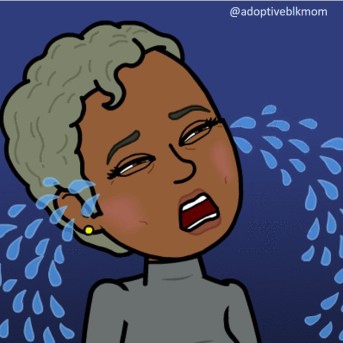
crying

I try to only look at her grades occasionally. I ask her about assignments and if she needs help. I encourage her to use a timer to help her manage time. I try desperately to leave it alone.

And it all drives me mad.

I have advocated for so many accommodations. I have spent a fortune on tutoring. I’ve tried new organizational tools. I’ve identified the incredible anxiety we both have about school.

I’ve tried to just let it be and try to work itself out along with Hope experiencing the consequences of not doing her part in the areas where she can.

And still I am filled with a mess of emotions about Hope and school.

I’m realizing that education is such a core value for me, something so important that 1) I can’t let it go and 2) I might not be able to fix this. And being a natural born fixer…this is a problem for me.

It’s not *just* that education is important; it’s been my gateway to upward mobility. I want that for Hope. I still have dreams of my daughter doing better than me in this life. I want her to have the cloak of protection that education kind of provides us. I want it so badly for her that the idea that school would be a struggle for her seriously never occurred to me during the adoption process. Her previous performance had been quite good. Now it’s the thing we struggle with the most.

Even after 3 years, I’m not prepared. I have exhausted all of my “I can fix this” pep talks. I have practiced laying this burden down, only to pick it up again a few hours later. I have pushed, coaxed, pleaded, bribed, and lovingly reassured with no change in results. I have watched my daughter sink deeper into depression and I assume a lot of blame for that because I don’t think anything I’ve done has made her feel better. I have developed no new coping skills.

I do not know how to deal with this.

I just don’t know how any more.

I looked at a special school, but the $50K tuition made me suddenly remember the padlock code to the liquor cabinet without having to look it up.

Weekly I get so frustrated even though I know it’s not all Hope’s fault. I go to meetings only to quietly seethe when Hope refuses to participate in a semi-adult conversation because her emotional IQ is about age 5.

The whole thing makes me angry with the world.

The whole thing makes me wonder why I chose this path.

The whole thing makes Hope feel like a failure.

The whole thing makes me also feel like a failure.

We both are mad and ridiculously sad, and I can’t see any light in the tunnel we’re in.

I’m back to looking at tutors and special programs in hopes of helping Hope be successful. I’m also back to just trying to let it go so that she doesn’t think I also believe she’s a failure. She’s not.

So, the educationally dilemma is my true Achilles heel. It brings out both the best and absolutely worst in me and I have no idea what to do about it.


Thoughts on Searching

My family has long been interested in genealogy searches. Several members, including my mother, enjoy trying to find members of the extended family tree, trying to trace our lineage as far back as they can. This can be challenging given that African Americans were counted as property for so long in the US. Despite this reality, it remains an enjoyable exercise in unearthing our history.

More recently, my immediate family has gotten into the DNA testing game. My parents took the test and found all kinds of connections. Most stunningly, the test revealed the existence of a close relative none of us knew about.

We are all in the process of learning about each other, bonding and attaching, figuring out how we feel about all this new found information. The discovery has prompted a rush of emotions that can hardly be articulated as anything but overwhelming.

I had the pleasure of meeting my relative this weekend; at one point in the conversation I asked him what he thought about all of *this,* this being the discovery, how it fit into his life, how he’s managing all of this new information.

He acknowledged that it was overwhelming, but that he’d been wondering and curious for so many years. He had kind of resolved to himself that some questions would never been answered, but to have them answered and to experience acceptance was more than he could have imagined. It was all still settling in.

This wasn’t an adoption story, but I thought a lot about adoptees as he was talking to me. I like to consider myself an advocate of the adoptee voice, but honestly at that moment, that voice and the needs that come with it resonated so deeply within me.

People want to know who they are and where they come from. There’s a desire to connect somewhere, biologically. There’s a need to understand their origin, their history. This is why they search. They have questions, more questions than I could ever dream of.

I listened as my new family talked about wondering who they looked like, who their people were, did they have mannerisms like anyone related to them.

I watched him and marveled at how much he looked like us; I cried when he spoke because it was like listening to another close family member—nearly tonally identical. The mannerisms were so similar too, and yet, he never knew any of us.

It’s more than nurture; it’s nature, and it’s undeniable.

As I tried desperately to stop staring and focus on listening to my new extended family, I thought of all of the adoptees whom I have listened to, including my beautiful daughter Hope. We’ll be traveling to see her side of our family in a few weeks. I was reminded how important those connections were. I imagined how she must have felt when it seemed that she would never have contact with them again. I smiled when I think about how I look at her face and see her birth family. I watch her grow and how her body shape is morphing to look like her aunts. I see her genes coursing through her.

The search for birth families must be difficult. The call to search, the decision to heed the call, the desire and wonder to know what you’ll find at the end of the search and how it will make you feel. It must be so powerful, scary, joyous, heartbreaking and all consuming.

I know that sometimes it’s something feared by adoptive parents, but it shouldn’t be feared at all. We have puzzle pieces that we need to gather. This experience, which is still developing, has provided me with a greater sensitivity to understanding an adoptee’s compelling need to know and to seek out their families of origin.

I feel better about my own search for Hope’s birth mother last year. I told Hope I’d found her; she said she didn’t want the information. She might one day and I’ll be ready to give it to her. Supporting her desire to know is important, and it’s no threat to me and my relationship with my daughter. I knew it was important before, but now sitting in the midst of a different, yet similar situation has me doubling down on the importance of supporting adoptee searches for birth families.

Certainly, adoptees don’t need me wandering in their space and co-signing on their voice, but I hope that other adoptive parents understand and are more supportive of their sons and daughters who choose to seek out their people.

The siren of biology does matter, and our hearts must be big enough to help our families answer if we can.

*Featured Image: giphy.com

Hope and Worry

I’ve been parenting for about 1,140 days. I am a babe in the woods. I have triumphed, and I have fallen down repeatedly.

Lately, I question everything I’ve learned these couple of years, and I’m scared.

I love my daughter, Hope. I have done my very best to help her heal, to help her grow, to help her catch up. I have tried to protect her from the world that has been brutal towards her. I’ve tried to protect her from herself when she has been unkind. I have prayed for and with her; I’ve wished for her. I’ve poured myself into her healing.

And for all the improvement we’ve made together, it’s still only 1,140 days, and I feel like we are in a bit of a free fall right now. It feels like I can never do enough. As a natural fixer, I am feeling woefully inadequate right now.

Something is wrong, very wrong. I know that Hope is struggling more than usual. I started paying close attention to moods, to behavioral patterns, to details that I had let go of a while ago. There are so many clues that something is wrong. I’ve seen them; I’ve started ramping all the support systems up again. I reached out to the therapists. I’ve scheduled appointments. I’ve been steeling myself to get back to the state of hypervigilance I used to maintain. But, I’m feeling my age now, remembering how exhausting the constant need for awareness can be. I’m wondering can I really maintain that level of being for an extended period of time, now. I’m also wondering what happens if I can’t.

I’m also wrestling with my own guilt. How and why did I get lax? Was I really lax? How come I didn’t know we had started spiraling? Why didn’t I just maintain everything? How did I let it get like this? Is this even something I can fix? How hard will this get before it gets better?

Is this free fall my fault?

I know intellectually that it’s not my fault but that fact really doesn’t matter, does it?

I see my daughter struggling. It seems she’s struggling with everything right now. School is hard. Social stuff is hard. Home is probably hard too. Emotions are thick; memories are vivid and on some kind of repeating loop. There are constant stomach aches and nausea and headaches and stress induced rashes. There are binges. There are hard core study times that swing to complete immersion into escapist fantasies. There is exhaustion, that’s really depression that swings from days of insomnia to sleeping for 18 hours.

I see it, but I can’t fix it. I gather those long arms and legs up and occasionally cradle Hope. I try to cook her yummy food. I try to be home as much as I can. I try to give her space, but I also try to smother her with attention. I try to give her lots of opportunities to thrive and to experience as much or as little as possible. I am strict but not inflexible. I’m compassionate. I try to meet her where she is, but I also walk away sometimes wondering if I did the right thing.

I want to heal her. I want her to be able to shrug off the effects of her trauma so that we can deal with the social challenges of blackness and womanhood. The reality is that we rarely get to wrestle with those because we are stuck in the quicksand of trauma. Her trauma suffocates us both. I fight with myself trying to just be ok with her life performance and trying not to worry that every bad grade will prevent her from a bright future.

I’m constantly forcing myself to abandon everything I conceptualized and believed about success. Our success is different. I know that, but it’s hard to believe that conventionalism is completely inappropriate in helping Hope navigate. So many of my firmly held, deeply etched values about life are constantly challenged and it is discomforting, disorienting, and dismaying. My prayers lately have been distilled to, “Lord just let us get through this day with no drama.”

And I still feel like we’re failing.

So, right now, Hope is struggling, and I’m worried. I’m not panicked by I’m really worried about the future, and by future, I mean next week and the week after.

I’m leaning back into my strengths: looking for possible solutions, marshalling resources and leveraging connections. I have no idea what happens next—long term is now just next month. I do think my daughter knows I’m trying; I don’t know what she really thinks about my efforts, but I know she thinks I’m trying to help her. I’m hopeful that she will continue to see me as helpful, reliable and safe. I’m hopeful I can continue to be that for her.

Hope and worry are sitting side by side for me these days.


My Triggers

This morning, Hope and I snapped.

LGFacts

Ok, that’s not true. I snapped.

The morning routine is driving me up the wall. Hope is always running late. She’s rarely ready on time. She misses the bus often. I pack breakfast to- go in order to make sure that she has a solid breakfast. She’s always frazzled before she gets out of the door.

This means that I’m quietly frazzled before she gets out of the door.

It also means that we have zero meaningful conversation in the mornings. Usually I see her for about 90 seconds while she’s shoving her lunch bag in her backpack, grabbing breakfast and a filled water bottle that I’ve prepped. I screech to remind her to take her meds because despite them being *right there* in front of her she manages not to see them. *RIGHT THERE*

My mornings don’t start off being so frazzled. I rise around 5am to exercise and walk Yappy. This morning we walked for 2 miles. I feed him and start prepping breakfasts, coffee, making lunches. I shower and dress, do hair and make-up and resume my work in the kitchen. My own anxiety doesn’t kick in until about 7am, when I start mentally wondering if Hope will make the bus or not for another day.

Over the course of 30 minutes I get more anxious and probably a bit irritable.

By the time Hope comes out, I’m in my own quiet, anxiety spiral.

And today it came out, but what I really wanted to say was left unsaid as we exchanged barbs that continued via text message after she left for the bus.

This morning routine is not what I want. It’s not what it used to be, which is what I grew up with and what I had tenderly fostered for the last couple of years with Hope.

I grew up having breakfast with my family. We watched the news together. We prayed together. We talked about our agendas for the day and what time we would be home. We talked about our after school activities and about upcoming games. We also gossiped about my classmates.

We spent time together.

Since I forced Hope to use her alarm clock and get herself together in the morning, she doesn’t sit down for breakfast with me.

I want her to sit down for breakfast with me. I actually kinda need it. But it’s still new to her, and it’s not something motivating enough for her to hustle to make time for in the busy morning routine.

For the last couple of months, my subconscious has read that as, “She does not find you important enough to spend 10 minutes having breakfast with you.”

That gets extrapolated to: “She does not appreciate how hard you work to make it all happen everyday.”

That gets blown up to: “She is selfish and lazy.”

That goes next level with: “She clearly doesn’t love me, and we might have attachment issues.”

Which climaxes with: “Fine!!!! I don’t like you either! You spoiled, ingrate!!”

LGAngry

And the anti-climax? “Why doesn’t she love me and want to have breakfast with me?”

Meanwhile Hope is like, “I can sleep until 6:30am and be ready 60-65% of the time, and I have a back up bus pass to catch the public bus. I’m good.”

giphy (4)

I now see that. I see the difference in our thinking. I now see that not having breakfast and having those moments to check in with Hope is a trigger for me. It’s not a trigger for her because she gets to prove that she is independent—something I’ve been encouraging for a long time.

Could it actually be that I miss her in the morning? Sigh.

I’m not sure why it’s hard for me to say, “Hey, having breakfast together is important to me. I want to have this time to check in with you in the morning. I’m feeling a little attention starved without a few quality minutes in the morning. I’m willing to limit my expectations to 2-3 days a week. Do you think you could do that for me?” But I know that I haven’t been able to do that. That is a new stretch goal.

Asking someone who seems to have little capacity for themselves to expend some capacity for you is hard. It’s so hard. But I know if I’m not honest with her then I’ll keep feeling this resentment that isn’t fair to my daughter or to me.

I have my own triggers, and those triggers have to do with wanting to spend time with my daughter.  Who knew, especially since she can be a special pill at the moment?

I just want us to have smooth, anxiety free mornings having breakfast with my daughter. Is that so hard to ask for?

Kind of.


There is No Magic

A few days ago Hope and I were in the car listening to a podcast. We were chuckling about the show, and then it ended and we listened to some of the commercials before the next podcast started. One of the commercials was about a new podcast on the magic of childhood.

I was only halfheartedly listening to the commercials. I caught the thought and let it slip through my mind.

But Hope was listening.

“There is no magic in childhood. None.”

She immediately had my attention. I didn’t know what to say.  All I could manage to say was, “Huh?”

“Magic? What’s magical about childhood? Nothing,”

We sat quietly at a light.

I quickly thought about all of her young years and the things she endured. I felt her trauma in my soul.

She didn’t say anything else, and I wasn’t sure what to say next. So, I didn’t say anything at all. It was one of the few times during our time together when I was completely stunned to silence. Usually, I can come up with something, but I had nothing. And I was just overwhelmed by the absence of magic in my daughter’s childhood.

I understand how she concluded that the magic of childhood was nothing but a farce. It breaks my heart. I have these fond memories of growing up. I remember my parents love. I remember birthday cakes and playing in the street with neighborhood kids. I remember when they took me and my sisters to Disney World and numerous other family trips. I remember feeling safe and loved. I remember so many little details that are clear to me know but seemed magical then.

I know that there are some memories that Hope has with her first family that are happy memories, but the number of those moment to moment memories are dwarfed by memories of instability, fear, and profound grief. The latter so crushing that she can barely see the good stuff in her mind. And she can’t separate those memories and just erase the bad ones. She has figured out how to reconcile the bad stuff; she can’t partition it to try to create some magic.

The magic of childhood is lost to her.

I wish I could change it all for her. I can’t, but I wish to hell like I could.

I have spent a lot of time and resources on helping Hope heal. I didn’t realize that I was also trying to create some magic in the waning years of Hope’s adolescence. I try to give her big and small experiences that will stick with her. I’m hoping they are special, magical, but knowing that she doesn’t think there’s any magic in childhood just makes me feel so sad.

I wonder will she still feel this way years from now when she has her own child? Did my silence, my failure to offer some wisdom about childhood magic, just reaffirm her grief? What can I do to make magic for her? Can I still create some magic for her?

I honestly don’t know what was I supposed to say in that moment that would validate her but offer a different narrative. I still don’t know what I was supposed to say to that declaration. I just don’t know what to say about there being no magic in childhood.


ABM & DAI – The Sequel

ETA: Apparently the link to this piece on the DAI site is no more. I’ve decided to post the original here! Enjoy!

Hope and I are alike but we are also very different.

We are both black. We both have families from the Southeast of the U.S. We both love music but completely different genres. We both are talented but in very different ways. We both wear our hair naturally —  in its kinky, coily state. And that’s about it.

Most folks who come into contact with us assume that I birthed her; after all, we are a same-race adoptive family. Folks assume that because I’m educated, then Hope must love school and do well in school. She hates it. Folks assume that Hope is a young, social justice militant like her mom. She’s not. Folks assume that Hope is and always has been comfortable with being in a middle-class home. She’s not but she’s trying to be.

It’s these differences that spark a bit of conflict in our lives. To sort of quote the late author Bebe Moore Campbell, Hope’s black ain’t like mine. When Hope was placed with me at the age of 12 (she’s now 15), we struggled with many things in the early months. After the difficult adjustment episodes passed, we began to realize that our concept of what it meant to be “black” was vastly different.

I grew up in a stable home with both parents who valued education. My mom stayed home with my siblings and I until we were all in school. We took road trip vacations. My father worked overtime to make it all work. Things were tight but never unstable.

Hope never knew that kind of stability, and she didn’t know many if any, black folks who did. For her, blackness was associated with class — poverty, some homelessness and just getting back economically. She did take a few trips to visit grandparents and extended family in her early years but that was about it. She attached those experiences with being black rather than being poor so her concept of blackness was much narrower than mine. She was happy to be parented by someone who shared her skin color but our experiences were so vastly different that shared color was undermined by class difference. During our first year, she told me it was like I wasn’t even black.

Yeah, she snatched my black card.

Shortly after our adoption was finalized, Hope’s extended birth family found us. We embarked on a relationship with them. Hope began to tell me stories of her early childhood visiting her family and the things they used to do. It was something real and tangible, and it wasn’t just a familiar family lens that Hope viewed these memories through. These were her people and they were a version of black she could relate to.

Only it was different now. Hope had traveled a little. She had a passport. She was seeing a bigger broader world. Hope was solidly middle class and she was learning to lean into her economic privilege.

By the time we went to visit Hope’s family, awkwardness settled in. The rush of emotions was overwhelming — grief, joy, happy memories, sad memories, and anger.  It was a lot to process so the conflict between race and class wasn’t initially clear.

But on the long drive home, it certainly became a point of discussion. Hope shared her observations. Our families were very different but also very similar — supportive, loving and encouraging with mutual core values. But we lived differently. Hope was proud of the things we’re able to do but she questioned if her birth family could do those things too. She questioned her grandmother’s living situation. She wondered what life would have been like if she had experienced a kinship adoption.

She tried to reconcile this race/class thing. It was hard for her; it still is several years later. I kept saying that black folks come from all walks of life; there are still some shared experiences, but yeah, this class thing can make race look and maybe feel different.

Our relationship with Hope’s birth family is awkward. Some of our early “grown folks” conversations about Hope explored fighting the finalized adoption and who would have access. I was sympathetic but I was also clear. I welcomed a relationship, but given Hope’s history with her family of origin, I would bury them in court. I’m somewhat shamed by that threat now. Privilege allowed me to make it. Looking back, I now feel like a snobby jerk.

Transracial families aren’t the only ones who may have to struggle with issues of race. Because class issues can overlap race and racial identity so much, those of us in same-race adoptions may also struggle with healthy racial identity development when our children move from one social class to another.

Hope is at an age where she’s trying to create her own identity. She also chooses to align herself and her friendships with all non-black peers. Certainly, there may be a lot of reasons for that, but the class conflict and how that shapes the way Hope sees herself plays a big role in her relationships, including and especially those with her birth family.

Class and privilege shape as much of Hope and my relationship with her birth family as any of the biological connections. We are all a work in progress. As an adoptive parent, I realize how important it is for Hope to have a relationship with her birth family. It’s important for me too. It’s my goal to make it all accessible for this big family of mine. This means teaching my daughter to learn to be aware of her privilege, how to prevent it from negatively affecting her relationships, and finally, how to use her economic privilege for good. It’s another set of lessons and values on a mess of healing, course corrections and personal and family growth, but important, so like with all the other stuff, we’ll do it.

____________________________________________________

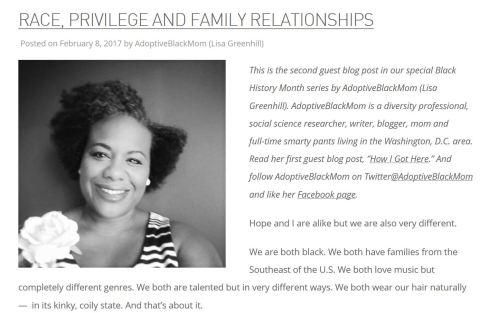
I am so excited to share the second part of my series with The Donaldson Adoption Institute! In this post I discuss how same race adoptive families of color can also struggle with racial identity issues.  Sometimes class and race issues are socially tightly knit together.

For our children coming from hard places, becoming a part of a new family is a paradigm shift.  They may be struggling with big emotions like grief and fear; they are learning to be a part of a family that is likely a lot more functional that what they understand…there are new people, new schools, new everything. Often times there are also more resources.

My daughter Hope had a very different understanding of what it meant to be black before meeting me. It’s been a challenge for her to reconcile that black folk are not a monolith. Whether she or I want to admit it or not, the truth is that Hope is a solidly middle-class kid now. Most of the time she seems comfortable with that, but in this Dondalson post I talk about when it’s not quick so easy for her.

Again, I’m delighted that the organization thought my voice was important and valuable. I’m totally jazzed that the good folks there have decided to feature my story as in honor of Black History Month.

Here is the link to the second of my two-part series over on the Donaldson Adoption Institute blog.  Be sure to stop by their Facebook page and hit them up on Twitter too!
dai

RACE, PRIVILEGE & FAMILY RELATIONSHIPS


K E Garland

INSPIRATIONAL KWOTES, STORIES, and IMAGES

Riddle from the Middle

real life with a side of snark

Dmy Inspires

Changing The World, With My Story...

Learning to Mama

Never perfect, always learning.

The Boeskool

Jesus, Politics, and Bathroom Humor...

Erica Roman Blog

I write so that my healing may bring healing to others.

My Mind on Paper

The Inspired Writing of Kevin D. Hofmann

My Wonderfully Unexpected Journey

When Life Grabbed Me By The Ears

imashleymi.wordpress.com/

things are glam in mommyhood

wearefamily

an adoption support community

Fighting for Answers

Tales From an Adoption Journey

Transracialeyes

Because of course race and culture matter.

SJW - Stuck in the Middle

The Life of Biracial Transracial Adoptee